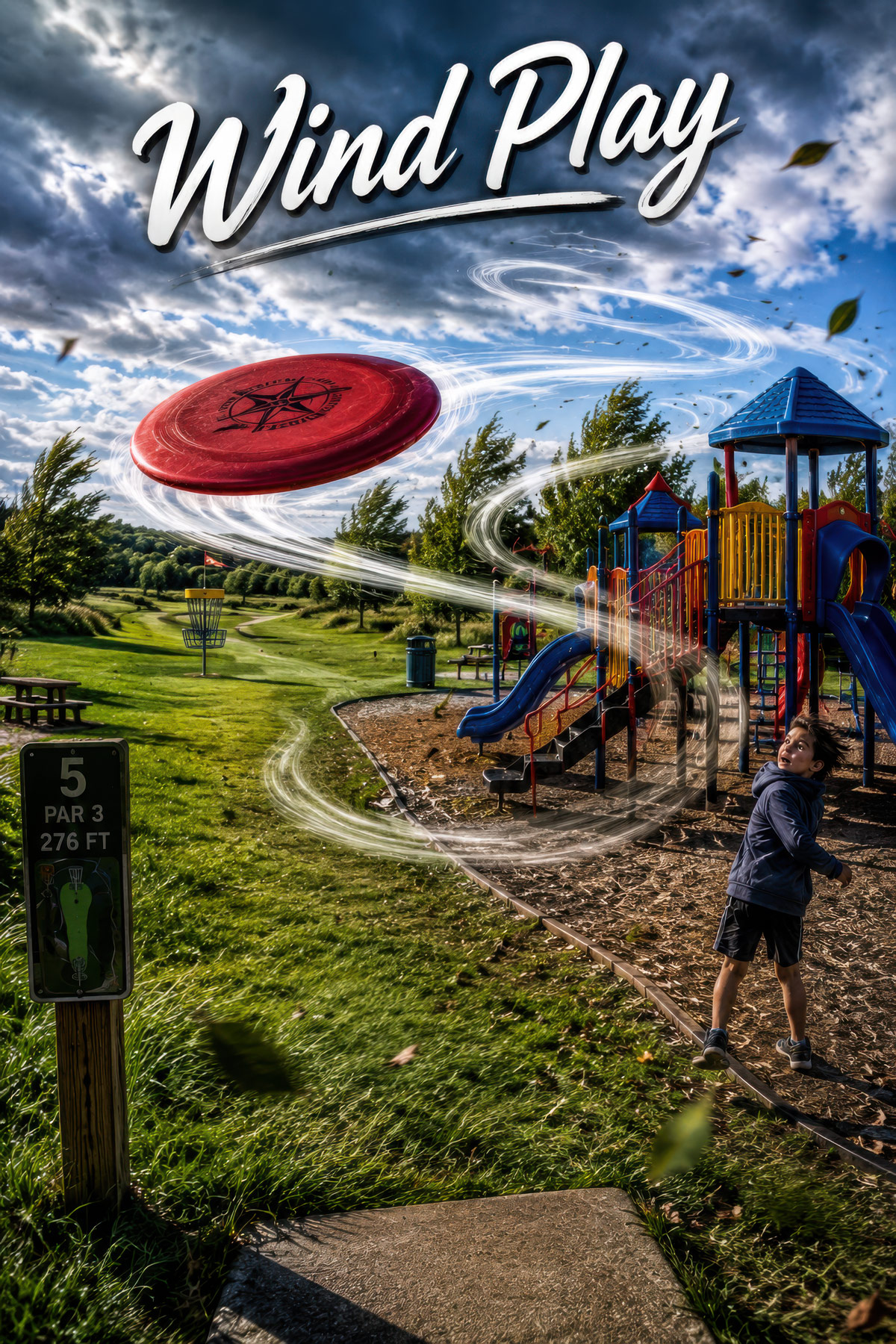
Wind Play
Definition: Wind Play is the practical skill of adapting disc golf decisions and execution to moving air. The player reads conditions along the expected flight, chooses a disc and release suited to the current objective, allows for imperfect results, then learns from what the disc actually does. Recognizing a headwind, tailwind, crosswind or quartering wind is only the starting vocabulary. Wind play includes shot selection, flight height, control of bank and nose angle, and landing consequences. It can mean using a breeze for distance, refusing a dangerous line, or laying up to avoid an exposed comeback. The air may change while the disc is aloft, so capable wind play is an informed response to uncertainty, not the elimination of it.
Why It Matters: Without a method, gusty golf becomes a series of improvisations that are impossible to learn from. A player changes the disc, adds power, raises the flight, misses badly—and cannot tell which adjustment mattered. A more useful sequence starts with what the air appears to be doing, chooses the ordinary miss the hole can tolerate, and makes a controlled attempt. If the outcome differs from the forecast, the next decision incorporates that evidence rather than the player’s annoyance. The reward is not mastery of the weather. It is a game that remains coherent when familiar calm-air solutions lose reliability.
Term Observations:
- Before choosing the disc, locate the consequence. If an unexpected lift could carry the flight into a creek or out-of-bounds, a wider receiving area may matter more than an aggressive flight-shape correction.
- Try an open-field test with one familiar disc: predict a landing corridor, throw at manageable effort, then note where your prediction differed from the result. On the next attempt, change ONE variable. Otherwise the wind gets credit for every good answer and blame for every bad one.
- A low, relatively flat shot often avoids prolonged exposure. It still needs room to clear roots, rising ground and a rough finish. “Keep it low” is advice, not immunity from geography.
- A shot in a headwind may justify a more turn-resistant disc. A shot in a tailwind may prefer one that continues flying at lower relative airspeed. Neither rule erases the importance of a player’s demonstrated release.
- Ron Convers Jr. recounts an entire card repeating an unsuccessful wind read. Watch both how the disc left the hand and how it behaved. The fourth thrower can learn from the first without pretending all four discs were identical.
- A putt worth running in calm weather can be the wrong wager when the far side of the green threatens a downhill or headwind comeback. Choose the score you are trying to protect before deciding what “aggressive” ought to mean.
- When conditions become hazardous at a sanctioned event, the issue stops being clever shot shaping. PDGA Competition Manual §1.07 provides for suspension by the Tournament Director in dangerous conditions. Safety outranks wind practice.
- A windy round can become a useful notebook. Not because the air behaved itself, but because the player learned to observe before venturing the shot.
References
References
- Riley O’Neill, “Tips for Playing Disc Golf in the Wind”. Innova Disc Golf, 15 June 2023. Accessed 14 October 2026.
- Ron Convers Jr., with Brendan Hickman, “Mastering the Wind, page 1”. Discraft Disc Golf Resources, Undated. Accessed 14 October 2026.
- Ron Convers Jr., with Brendan Hickman, “Mastering the Wind, page 2”. Discraft Disc Golf Resources, Undated. Accessed 14 October 2026.
- NASA Glenn Research Center, “Relative Velocity”. NASA Beginners Guide to Aeronautics, Undated (live instructional page). Accessed 14 October 2026.
- Professional Disc Golf Association, “Competition Manual §1.07 — Suspension of Play”. PDGA Competition Manual, 2026 compilation. Accessed 14 October 2026.
© 2026 North Georgia Canopy Tour Property, LLC d/b/a DiscLula. All rights reserved.