Safe Play
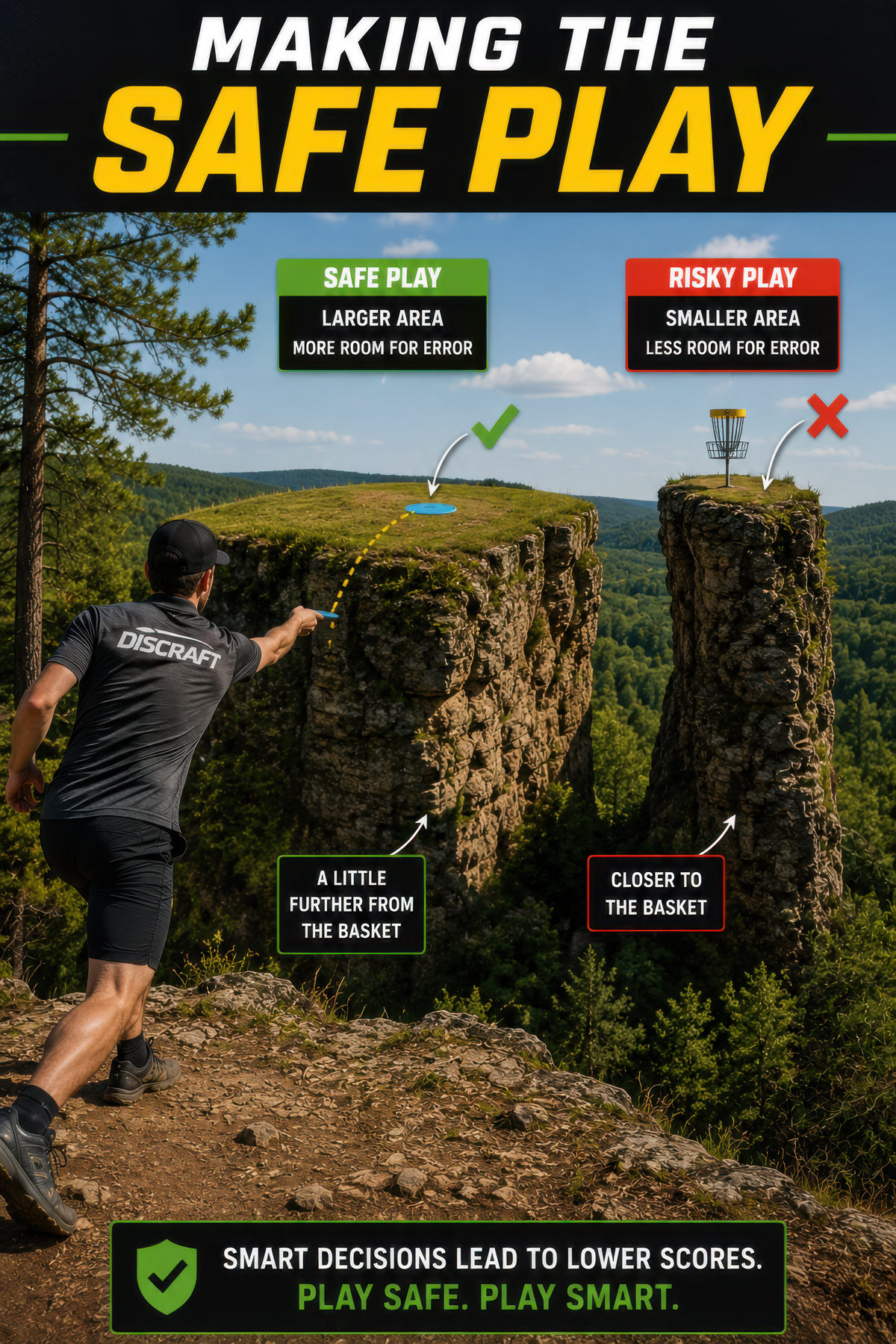
Definition: Safe Play is a tactical choice intended to reduce the likelihood or cost of a damaging miss from the lie at hand. It might be a layup short of water, a wide approach around trees, or a full-speed throw into a forgiving landing area. Safety is relative to the player’s skills, likely misses, and what the resulting lie allows next. It is not simply the shortest throw, and it is not a rule that caution must prevail over every scoring opportunity. The term concerns scoring strategy.
Why It Matters: A useful safe play buys space from an out-of-bounds edge, room for an ordinary release error, or a next approach that can be made from firm footing. That benefit vanishes if a tentative throw catches the wrong tree or a harmless-looking landing leaves no workable angle. The player should select a specific receiving area, match a familiar disc and flight to it, and account for skip, slope, and the next stance. When protecting a lead, that margin may be worth more than a remote birdie chance. When only a birdie can advance the player, the same cautious choice may no longer fit the job.
Term Observations:
- The safest-looking patch can be a trap. Imagine grass short of a dogleg that leaves the basket entirely hidden behind trees. A slightly farther landing on the outside of the turn may carry more immediate flight risk but produce a simpler next throw.
- Name the grass, not the danger. “Do not reach the creek” gives the hand nothing to aim for; “finish in the broad flat area before the bank” describes both a target and a margin for the skip.
- At Sherwood Disc Golf Course, Steve Andrews described a 150-foot approach with wide-open space left of a guardian tree. Choosing that generous side loses its advantage if the player cuts within inches of the trunk simply to make the putt shorter.
- Commit to a short throw as fully as to a long one. Half-attention does not become wise because the planned distance is modest.
- Sometimes the safety margin is not airspace but ground. An approach that lands ten feet from the pin and rolls toward an OB slope can be less useful than one settling thirty feet away on level ground.
- Two good intentions can cancel. Shifting the aim away from the hazard and switching to a disc that finishes still farther that way may send the throw into new trouble. Select the full flight, not independent layers of caution.
- Try a two-shot practice test: mark a generous landing region, throw into it, then finish the approach from wherever each attempt settles. A placement earns its reputation on the next throw.
- A safe play is not a resignation speech. It is a deliberate scoring move with a destination.
References
References
- Steve Andrews. Tuesday Tips: Commit to Your Line — And Your Disc. Ultiworld Disc Golf, 23 Nov. 2021; opinion/instruction. Accessed 14 October 2026.
- Steve Andrews. Tuesday Tips: The Pressure of Playing Smart. Ultiworld Disc Golf, 7 Dec. 2021; opinion/instruction. Accessed 14 October 2026.
- Professional Disc Golf Association. 806.02 Out-of-Bounds. Official Rules of Disc Golf, 2026. Accessed 14 October 2026.
- Professional Disc Golf Association. Official Rules of Disc Golf and Competition Manual for Disc Golf Events Updated for 2026. PDGA News, 28 Dec. 2025; effective 1 Jan. 2026. Accessed 14 October 2026.
© 2026 North Georgia Canopy Tour Property, LLC d/b/a DiscLula. All rights reserved.