Placement Golf
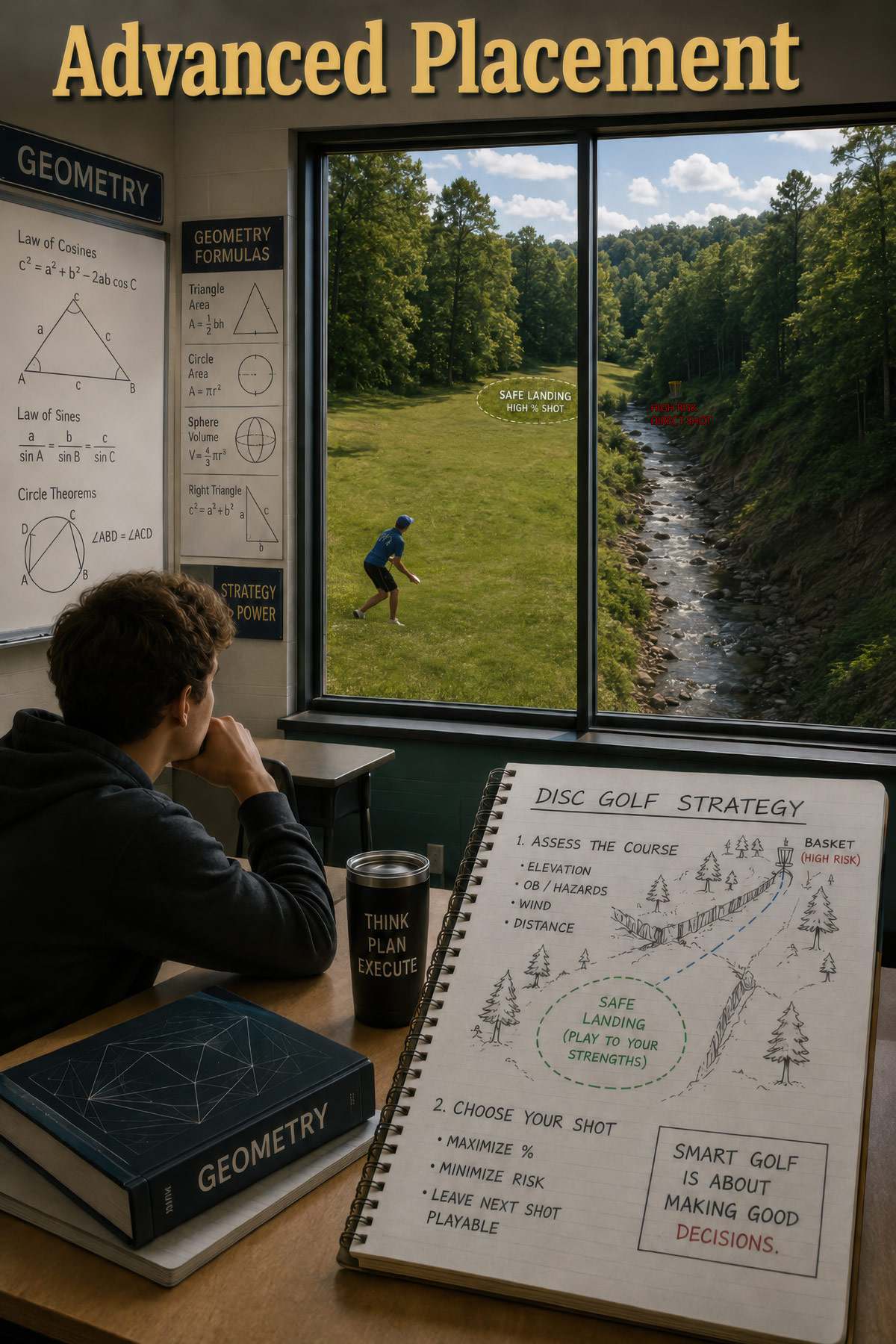
Definition: Placement golf is a position-first way of playing a disc golf hole. Rather than treating every throw as a separate opportunity to gain the maximum distance, the player selects a sequence of reachable areas that offer useful angles and manageable follow-up shots. It is especially visible on doglegs, wooded fairways, and longer holes where one throw's finish determines the next throw's possibilities. Placement golf does not avoid all risk or require short throws. Distance is valuable whenever it improves the plan. A placement shot is an individual throw within the sequence; placement golf is the larger playing approach that gives each throw a reason.
Why It Matters: Consider a par-four hole with a bend around a stand of trees. The longest available drive may finish nearer the basket but leave a steeply obstructed approach. A shorter drive that stops at the bend may open a familiar fairway shot and a comfortable putt. The choice is not distance versus character; it is a comparison of complete routes available to the player. Placement golf becomes useful when holes demand two or more decisions and when the next shot's angle matters as much as the current shot’s length. Placement golf is not automatically superior to an attack: needless lay-ups can leave harder work later. The art is making each part of the route assist the next, without pretending the hole will always accept the plan.
Term Observations:
- Walk the hole backward in your imagination. From the basket, identify an approach lane you know how to throw. Then find where a first throw must finish to open it. Reverse engineering works better than wishing after the drive.
- The middle can be the most important part of a hole. A scenic tee and a guarded green command attention; the patch of open ground between them may quietly decide whether either can be reached sensibly.
- In his 2023 course-management essay, Steve Andrews recommends building scoring plans around the shots players can actually produce. Borrow the method, not a stronger player's distances. The fairway does not adjust its dimensions for ambition.
- Placement can be aggressive. A long controlled drive to the far edge of an open landing area may create a better route than a timid toss to the first safe grass. Useful distance is part of positioning.
- A right-hand backhand specialist and a forehand specialist might use different landing areas on the same dogleg. The 'best' placement depends on which approach each player can repeat, not on a universal dot painted on a map.
- The first useful lie might not be the closest one. Terrain, trunk positions, and the available stance make a short remaining distance either generous or miserable.
- If a plan collapses after a tree kick, placement thinking remains useful. Choose the next reachable open area; abandon only the original route, not the habit of preparing what comes after.
- Two comfortable throws are still two throws. When one reliable attack can remove a throw without unreasonable downside, placement golf should consider it rather than insist on visiting every planned station.
References
References
- Steve Andrews. Tuesday Tips: Break The Disc Golf Course [Your Best Year Ever]. Ultiworld Disc Golf (17 January 2023). Source. Accessed 14 October 2026.
- UDisc editorial staff. Deep Dive: How Disc Golf’s Precise Power Index Works. Release Point — The UDisc Blog (undated here; precise date not independently established). Source. Accessed 14 October 2026.
- Professional Disc Golf Association. 806.02 Out-of-Bounds. Official Rules of Disc Golf (2026 edition; page last updated 31 December 2025). Source. Accessed 14 October 2026.
© 2026 North Georgia Canopy Tour Property, LLC d/b/a DiscLula. All rights reserved.