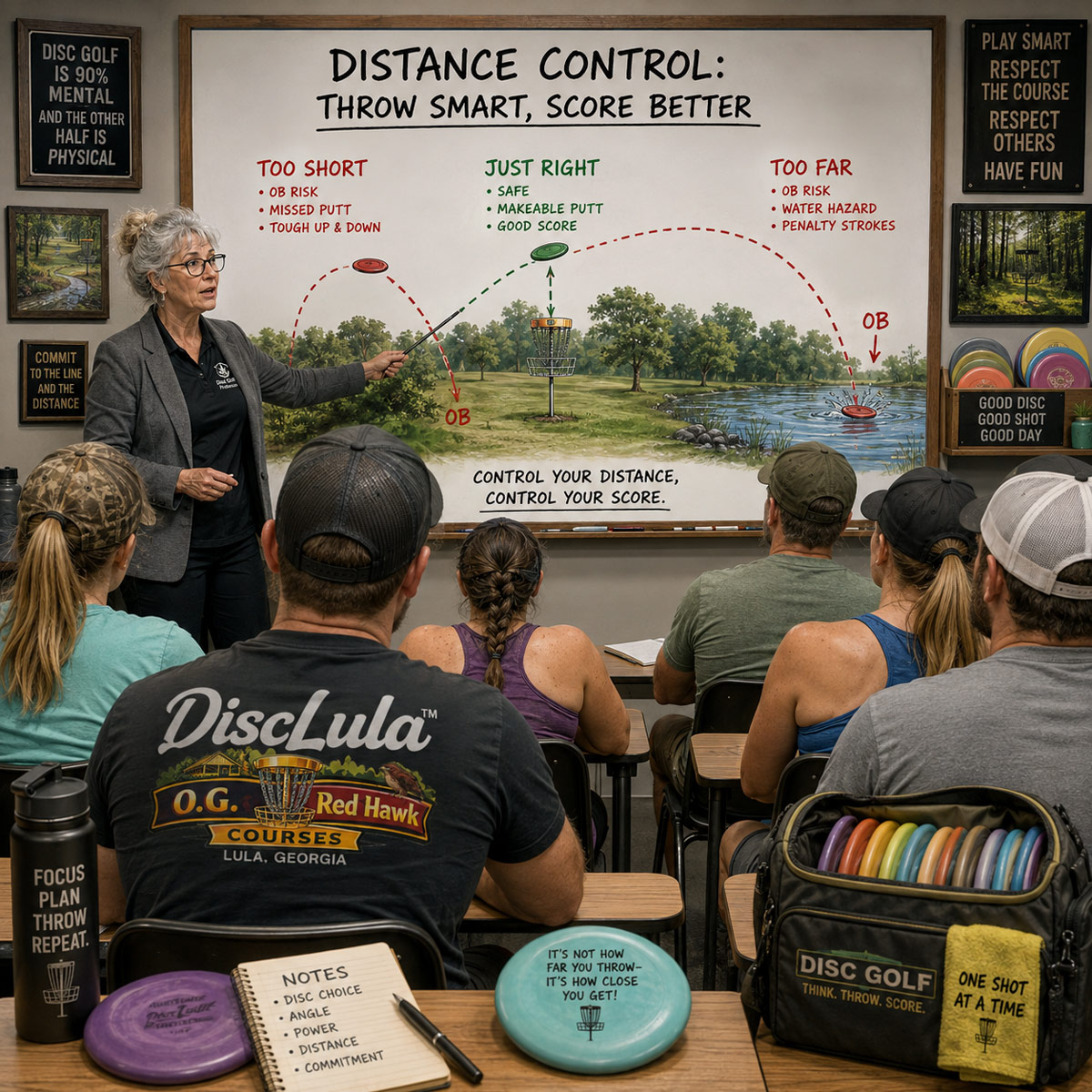
Distance Control
Definition: Distance control is the ability to regulate how far a disc travels and where it is likely to finish. In disc golf, this can mean a gentle approach that settles short of a drop-off, a drive that reaches a planned landing band without running through it, or a putt with enough pace to reach the basket without an extravagant comeback if it misses. The player adjusts a combination of disc, speed, trajectory, and nose angle to the landing conditions. Distance control differs from carry distance, which concerns airborne reach, and from accuracy, which also includes lateral position and shot corridor. Controlling distance is not simply throwing less hard: it means matching a repeatable flight and finish to a chosen range.
Why It Matters: A few unnecessary feet can convert an inviting putt into an awkward lie. If the basket stands on a ridge, the useful throw may finish on the near side of the crest, even if its carry falls short of the pole. On long holes, a drive that stops before trouble can leave the same next shot as a longer drive - with less danger. Reliable distance control makes these choices available without requiring a miraculous touch on demand. Distance control is gained by noticing short and long patterns, comparing discs and lines, and practicing more than one distance. Course conditions still complicate the work: what checks up in soft grass may travel on packed dirt. The aim is a playable stopping range, not a single mathematically perfect point.
Term Observations:
- The basket is not a magnet. A disc that passes it by thirty feet has not 'almost' arrived in the way that matters for the next throw.
- Picture a raised green with rough beyond. From the fairway, a controlled approach that dies on the near edge may beat a straighter, harder throw that reaches pin-high before rolling down the back. Distance control can involve choosing the shorter-looking success.
- Practice with three landing bands at different ranges. Throw one deliberate shot at each, change the order, and record whether the first contact and final rest are short, inside, or long. Randomizing the targets teaches a different question than repeating ten throws to one familiar spot.
- A 'touch' shot still needs an intention. Choose where the disc should begin to slow, what height it can afford, and how much surface travel is acceptable. Vague softness is hard to repeat.
- Wind and elevation complicate the ruler. A downhill approach can remain aloft longer than a comparable throw on level ground; a headwind may change both flight and finish. Treat remembered yardages as conditional observations, not sworn distances.
- A faster disc at reduced effort may stall or fade in a way a slower disc thrown cleanly would not. Compare the actual landing pattern before deciding which one is your distance-control tool.
- Stop measuring success only by your closest disc. Note the long misses and the short misses separately. A cluster consistently twenty feet past a target is easier to diagnose than a collection of memorable near-misses.
- A controlled shot leaves the next stroke ordinary. The distance was managed so that the game did not suddenly demand a rescue mission.
References
References
- Riley O’Neill. Master Your Approach Game. Innova Disc Golf, 19 June 2026. View source. Accessed 14 October 2026.
- Alex Williamson. Build Your Accuracy & Love Doing It. UDisc / Release Point, 15 April 2020. View source. Accessed 14 October 2026.
- Kyle Giovannini and Alex Williamson. How To Throw Upshots/Approaches In Disc Golf: 5 Great Videos. UDisc / Release Point, 23 March 2020. View source. Accessed 14 October 2026.
- Riley O’Neill. Flight Numbers Made Simple. Innova Disc Golf, 21 April 2026. View source. Accessed 14 October 2026.
© 2026 North Georgia Canopy Tour Property, LLC d/b/a DiscLula. All rights reserved.