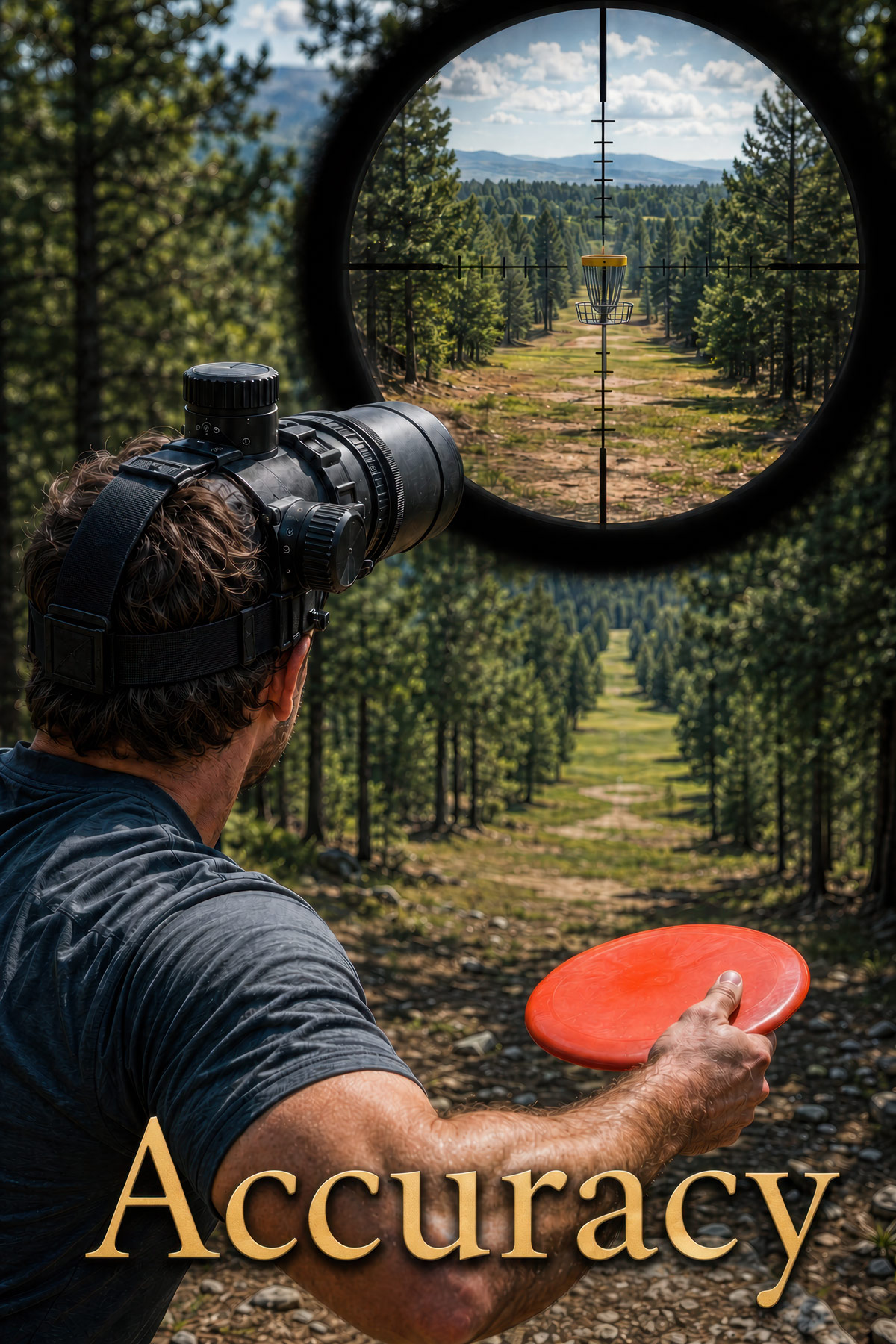
Accuracy
Definition: Accuracy is the ability to send a disc to the intended spot. That may mean threading a gap or reaching the basket; it may mean finishing on a particular patch of fairway with an open look at the next throw. The flight matters—its direction, height, angle, and shape—but so does the landing. A disc can pass perfectly between two trees and still finish in a place nobody wanted. Accuracy is therefore more than hitting what you aimed at: it begins with choosing a useful target and continues through the flight and its finish. It is distinct from distance control, which chiefly concerns how far the disc travels, though the two often work together.
Why It Matters: A few feet can change the entire next throw. A drive parked behind a tree may leave a worse approach than a shorter drive settled in the open. On a wooded hole, the first opening is only the beginning; a disc that catches the correct gap at the wrong height may drift or skip into trouble. Good accuracy turns course strategy into repeatable choices: which corridor to enter, which side of the fairway to favor, and how much finish to allow for the ground. It can protect scoring opportunities and reduce exposure to out-of-bounds areas, where the rules may add a penalty throw. Even when the basket is visible, the smartest destination may be elsewhere.
Term Observations:
- The bullseye is not always the basket. On a dogleg, the best drive may stop short, in plain sight of the turn, while the longer throw disappears behind the corner.
- A gap has an entrance and an exit. A disc that splits the first two trunks only to swing into the next one has completed half the assignment. Trees are remarkably strict graders.
- Choose the landing before you choose the heroics. Ask where the next throw should begin; only then decide which disc and shot shape can put you there.
- The ground gets a vote. A low, fast landing may skip beyond the planned spot; a softer arrival may stay nearby. Read the surface as carefully as the air.
- Aim small enough to learn, not so small that practice becomes a coin toss. Mark a sensible landing zone and throw a set of discs at it. Record how often they finish there, not just the prettiest single flight.
- Wind does not care where you were pointing. Crosswinds, nose angle, disc stability, and release conditions may move the eventual finish; select a flight that gives those effects room.
- Accuracy is a decision before it is a measurement. A throw can be perfectly executed and strategically foolish if it reaches the wrong target.
- The next shot is quality control for accuracy. If it is easier because of where this disc finished, your choice of target was probably doing useful work.
References
References
- Professional Disc Golf Association — 806.02 Out-of-Bounds. Official Rules of Disc Golf, updated 31 December 2025 / 2026 rules. Accessed 14 October 2026.
- Professional Disc Golf Association — Official Rules of Disc Golf and Competition Manual for Disc Golf Events Updated for 2026. PDGA News, 28 December 2025. Accessed 14 October 2026.
- Professional Disc Golf Association — Official Rules of Disc Golf. PDGA rules portal, revision 1 January 2026. Accessed 14 October 2026.
© 2026 North Georgia Canopy Tour Property, LLC d/b/a DiscLula. All rights reserved.