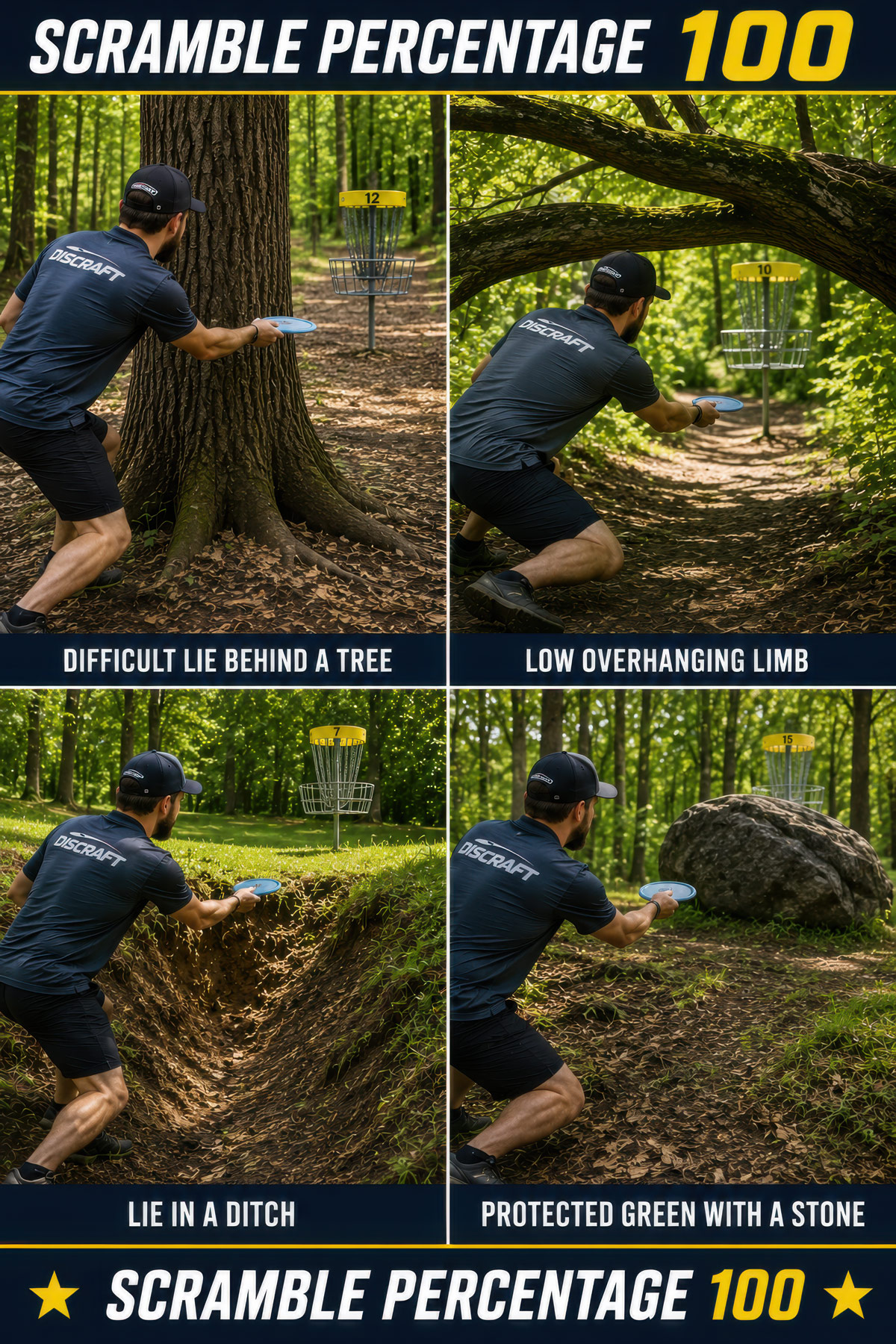
Scramble Percentage
Definition: Scramble percentage is the share of qualifying trouble holes on which a player achieves a statistic’s required recovery result. Under UDisc Live’s documented 2020 definition, a hole qualifies if the player throws out of bounds or off the fairway at any point, and it counts as a successful scramble if the player still scores par or better. Count qualifying holes saved, divide by all qualifying holes, and multiply by 100: three successful saves in five opportunities give 60 percent. This is a provider-defined measure, not a universal PDGA scoring category. Other systems—or earlier versions of the same system—can count trouble differently. The numerator and denominator belong in the same sentence as the percentage.
Why It Matters: The percentage separates the damage a player suffers after trouble from the amount of trouble encountered. Used carefully, it can expose recurring difficulties: poor exits from rough, approaches that leave demanding putts, or missed conversions after sound recoveries. Used carelessly, it can praise a player who repeatedly needs rescue while overlooking a player who simply stays on the fairway. A statistic based on six qualifying holes is much less stable than one based on sixty, and differently defined opportunities cannot be compared fairly. The most useful reading asks not only whether a par was saved, but why the hole went wrong and whether the next decision limited further damage.
Term Observations:
- Begin with the denominator. Five qualifying holes, three finished at par or better: 3 ÷ 5 × 100 = 60%. Dividing by all 18 holes would answer a different question.
- One messy hole is still one qualifying hole under the documented UDisc Live convention. Two visits to the rough do not create two opportunities. The hole’s final score supplies one success or failure.
- UDisc changed its scramble-rate definition in 2020. Its earlier Live approach rewarded a par save after missing Circle 2 in regulation; the revised approach targeted off-fairway or out-of-bounds recovery, and historical Live results were recalculated. An unchanged column heading can conceal a changed question.
- A rescue rate is not a reason to need rescuing.
- In UDisc’s published 2023 FPO data, Kristi Unt completed 35 of 68 scramble opportunities (51.5%), while Kristin Tattar completed 113 of 231 (48.9%). Unt’s listed proportion was higher; Tattar’s recorded sample was much larger. Neither fraction tells how hard the individual lies were.
- If no holes qualify, do not report 100 percent. The denominator is zero, so the rate is undefined for that sample. ‘No scramble opportunities’ is an accurate label; the software’s display convention may differ.
- A sensible pitch-out that accepts bogey can be the right competitive decision even though it fails the par-or-better scramble test. Protect the total, not the percentage. A statistic is a witness, not the tournament director.
- Study the failed saves by cause. A blocked exit, an approach left in the open but too far away, and a missed short putt all count as a failed scramble when the qualifying hole ends over par. Each suggests a different kind of practice.
References:
- UDisc Staff. UDisc Live 2020 Updates. 19 February 2020. Verified 15 October 2026.
- Alex Williamson / UDisc. Pro Disc Golf Stats (FPO): Who Was Best in 2023?. 14 November 2023. Verified 15 October 2026.
- Alex Williamson / UDisc. Pro Disc Golf Stats (MPO): Who Was Best in 2023?. 14 November 2023. Verified 15 October 2026.
- Professional Disc Golf Association. 808 Scoring. 13 February 2026 (page last updated). Verified 15 October 2026.
© 2026 North Georgia Canopy Tour Property, LLC d/b/a DiscLula. All rights reserved.