School Divisions
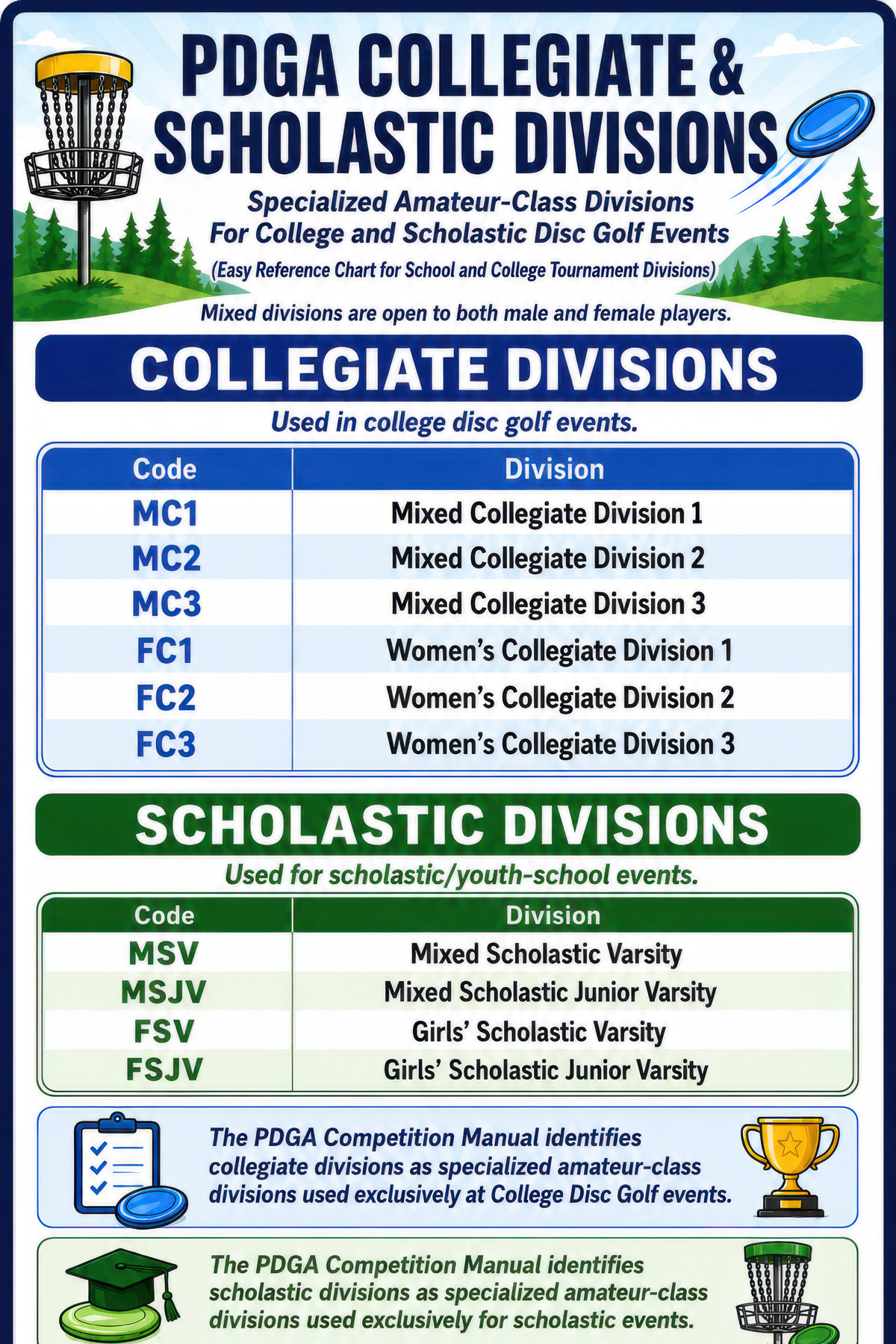
Definition: School Divisions is an umbrella term for collegiate and scholastic disc golf categories, not a single PDGA division code. The Competition Manual identifies both families as specialized Amateur-class divisions: collegiate categories are used exclusively at College Disc Golf events, and scholastic categories exclusively at Scholastic events. Their codes describe program categories rather than the ordinary numbered amateur ladder. Eligibility and format must be checked against the applicable program and event. Being a student, holding an amateur classification or wearing a school’s colors does not, by itself, establish eligibility for every school competition.
Why It Matters: School competition adds an organizational component to the usual question of which division a player can enter, whom may the player represent, and under what program rules? Players, coaches, and families need a single answer before registration. The relevant eligibility, roster, qualification and format requirements should be identified rather than inferred from a familiar division number. School affiliation is connected to the actual competition being offered, making results easier to read: a collegiate division number and an MA division number belong to different systems, even when some players may participate in both.
Term Observations:
- The collegiate family contains Mixed Collegiate Divisions 1–3, coded MC1, MC2 and MC3, and Women’s Collegiate Divisions 1–3, coded FC1, FC2 and FC3. These are the categories listed by the PDGA; the list does not require a particular event to offer all six.
- Scholastic codes distinguish Mixed Scholastic Varsity (MSV), Girls’ Scholastic Varsity (FSV), Mixed Scholastic Junior Varsity (MSJV) and Girls’ Scholastic Junior Varsity (FSJV). Junior varsity is a program designation here, not a substitute for a PDGA Junior age cutoff.
- Imagine an MA3-eligible student invited to join a school team. The MA3 rating check answers one question. Whether that student may represent the school in the proposed event is a separate question for the program rules.
- A jersey identifies the team; the rules establish the entry. —DiscLula
- Before planning tactics, establish how the event is scored. If an event combines individual and team components, find out which results count and how. Do not assume that a familiar singles scorecard explains the whole format.
- Mixed categories allow eligible players regardless of gender. Women’s and girls’ categories require the applicable eligibility check as well as the program’s participation requirements. Neither part should be inferred from the division’s number.
- Read the results with the program beside them. First identify the category, then the scoring format, then the result. School pride can explain why a finish matters to people; it cannot replace the rules that explain what the finish means.
References:
- Professional Disc Golf Association. PDGA Competition Manual. Updated 2 January 2026. Verified 30 October 2026. 2.01 Division Types. Supports: §2.01.A–F: open, ratings-based, gender-based, age-based, collegiate and scholastic categories.
- Professional Disc Golf Association. PDGA Competition Manual. Updated 9 March 2026. Verified 30 October 2026. 2.02 Qualifications. Supports: Eligibility, amateur entry in professional divisions, mixed eligibility, offered divisions; §2.02.M local forced-move-up rules; §2.02.N players without a PDGA number.
© 2026 North Georgia Canopy Tour Property, LLC d/b/a DiscLula. All rights reserved.