Brace
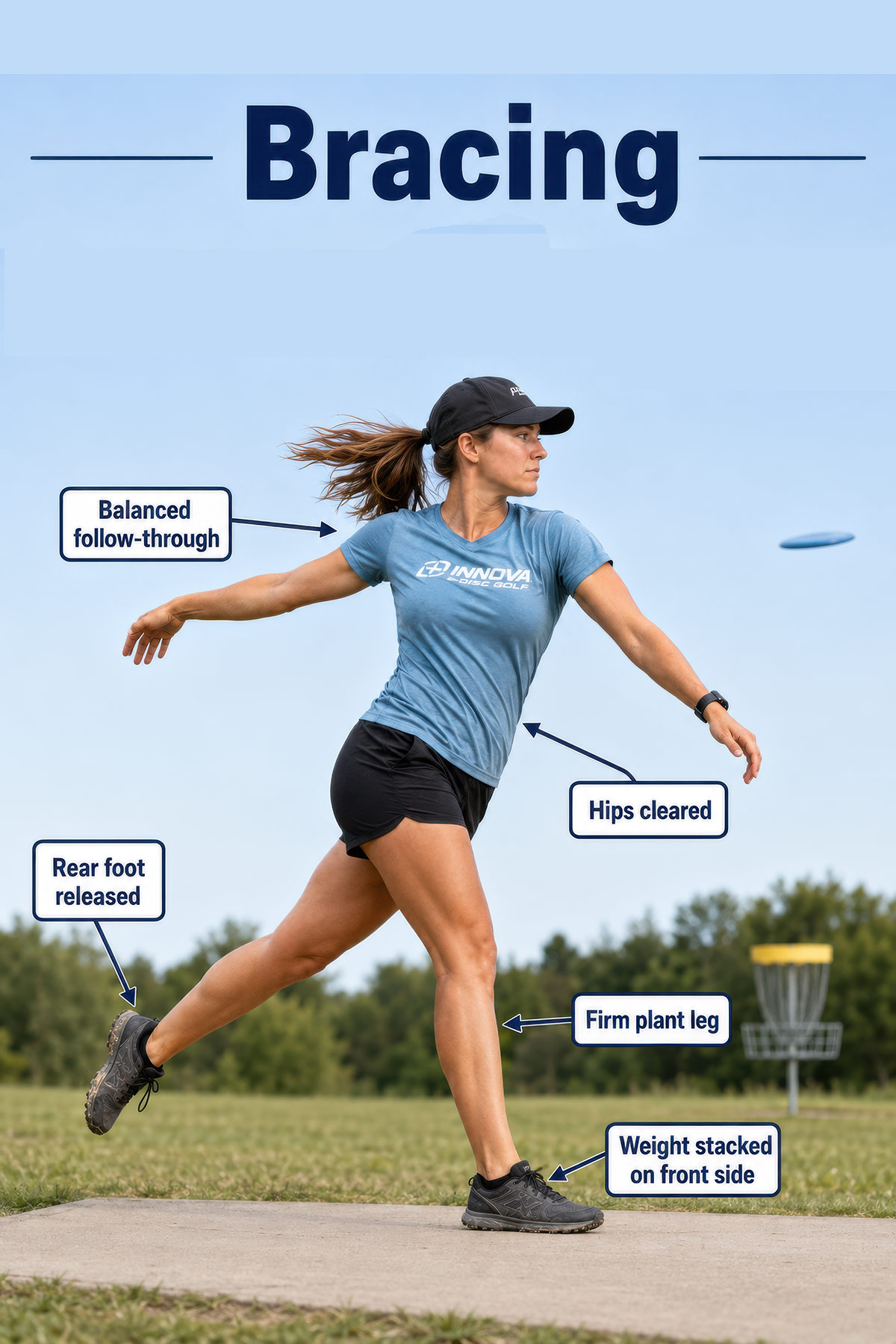
Definition: The brace is the controlled support provided by the plant side of the body as a player delivers a throw. In a backhand, the planted front foot and leg accept loading as weight shifts forward, helping manage forward movement while the body turns and accelerates the disc. Think of establishing a dependable base for the delivery rather than simply running through the release.
Bracing is part of a moving sequence. It does not require a locked knee, a rigidly upright posture, or a sudden stop to the whole body. Balance describes overall body control; weight shift describes the changing distribution of support; the brace describes how the plant side supports and resists movement during the delivery. A useful brace still allows a natural follow through.
Why It Matters: An effective brace helps the lower body, torso, and arm work together, giving the release a more dependable base. If the body keeps drifting through the plant, the player may have to compensate late in the throw. That can make the intended line and angle harder to repeat, even when the run-up looks impressively energetic.
The practical decision is whether more approach speed is helping you deliver the shot. On a drive through a narrow opening, a manageable approach with a controlled plant may serve you better than a fast arrival followed by hurried corrections. Bracing also matters during standstill throws, where the weight can shift without a running approach. Practice the support you can use, then add pace as the motion remains coordinated. More speed and a louder plant are not proof of a better brace; the disc still has to leave on the line you chose.
Term Observations:
- DiscLula expression: “Give the throw a foundation, not a roadblock.”
- Firm does not mean frozen. The plant leg helps support the delivery, but the knee need not be locked and the foot need not remain glued to the ground throughout the finish. Do not turn a useful cue about resisting forward drift into an instruction to stop every moving part.
- A step after release does not, by itself, show that the brace failed. Watch when the movement occurs: drifting through the plant during delivery and stepping naturally into the finish are different events. Within the putting area, the separate PDGA balance requirement still applies.
- For a practice check, film a few comfortable standstill or one-step backhands from the side, with the camera safely outside the throwing line. Watch the plant, delivery, and finish as one sequence, then compare the flights. A freeze-frame can identify a position; it cannot tell you how you arrived there.
- In his 2016 “Feet Together” drill article, instructor Jason Liebgott uses a simplified stance to teach support against the plant side. The drill is a learning tool, not a requirement to throw every drive with your feet together.
- Forehands also depend on coordinated lower-body support, but their stance and sequence differ from a backhand’s. Keep the principle of an organized delivery without copying the same foot position or assuming that every cue transfers unchanged.
- Bracing is coaching language, not a PDGA requirement to use a particular throwing technique. The rules govern supporting points at release: see 802.04 for tees and 802.07 for marked lies. A powerful-looking plant can still be in the wrong place.
- Do not put the front leg on trial for every bad flight. Grip, nose angle, release direction, disc choice, and timing still matter. Work on the brace when the movement gives you a reason to; a disappointing throw alone is not a diagnosis.
References and source notes
Sources supporting the Brace entry in the DiscLula Disc Golf Lexicon. All links accessed October 9, 2026, using America/New_York time. Coaching sources describe teaching approaches; PDGA sources establish the rules requirements.
1 Support against the plant side
Jason Liebgott. “Feet Together” Drill Brings More Balance To Your Swing. Ultiworld Disc Golf, May 25, 2016.
https://discgolf.ultiworld.com/2016/05/25/feet-together-drill-balance/
Claim supported: Supports the use of a simplified stance to teach loading and support against the plant side, and verifies the named drill and its author in the observations.
Scope: This is the instructor’s own explanation, not a controlled study. Its posture cues are teaching tools; this entry does not treat them as mandatory positions for every shot.
2 Coordination and manageable approach speed
Riley O’Neill. How to Throw Backhands… Really Far. Innova Disc Golf, February 24, 2026. Sections “Plant First, Then Throw” and “Timing Is Everything.”
https://www.innovadiscs.com/innova-news/how-to-throw-backhands-really-far/
Claim supported: Supports coordinating the plant with the throwing sequence and treating timing as more useful than simply increasing effort. This informs the practical discussion in Why It Matters.
Scope: Manufacturer-published coaching guidance, not experimental proof of a universal sequence or a quantified gain. No exact knee angle, force threshold, or ideal run-up speed is prescribed.
3 Forehand support and differences in technique
Riley O’Neill. Level Up Your Forehand. Innova Disc Golf, March 19, 2026. Sections “Grip and Run-Up” and “Avoid the All-Arm Throw.”
https://www.innovadiscs.com/tips/how-to-throw-forehands-accurately-far-and-without-injury/
Claim supported: Supports lower-body and torso involvement in forehand delivery, with variation in run-up and grip. Used for the observation that the same broad support principle does not require identical technique.
Scope: Only the coordination and technique-variation guidance is used. The article does not establish one universal forehand brace position, and its injury-related assertions are not adopted here.
4 Release stance on tees and marked lies
Professional Disc Golf Association. Official Rules of Disc Golf, 802.04 Teeing Off and 802.07 Stance.
https://www.pdga.com/rules/official-rules-disc-golf/80204
https://www.pdga.com/rules/official-rules-disc-golf/80207
Claim supported: 802.04B requires at least one supporting point within the teeing area and all supporting points within it at release. Supporting contact outside that area is permitted before or after release.
Scope: Companion rule 802.07A requires contact with the marked lie, no supporting point nearer the target than the marker’s rear edge, and all supporting points in-bounds. These regulate stance rather than prescribe bracing mechanics.
5 Balance after a putt
Professional Disc Golf Association. Official Rules of Disc Golf, 806.01 Putting Area.
https://www.pdga.com/rules/official-rules-disc-golf/80601
Claim supported: Supports the qualification to the follow-through observation: after a putt from within 10 meters, the player must demonstrate control of balance behind the marker before advancing toward the target.
Scope: This specific restriction must not be lost when explaining that post-release movement can be natural. It is a rules requirement, not a general demand to freeze after every throw.
6 Throwing methods and rules authority
Professional Disc Golf Association. Rules Questions and Answers, QA-THR-2; Official Rules and Regulations of Disc Golf overview.
https://www.pdga.com/rules/official-rules-disc-golf/questions-and-answers/
Claim supported: QA-THR-2 permits different throwing methods. Read with the stance rules, it supports distinguishing coaching terminology from a requirement to throw using one particular technique.
Scope: The rules overview identifies the online rules as authoritative and lists revisions. Recheck the rules before the January 2027 press date; this review records the rules consulted on the access date.
Editorial provenance
The definition and practical examples are editorial synthesis. The filmed practice check is an editorial suggestion, not a validated test. The foundation-and-roadblock phrase is labeled as a DiscLula expression and is not attributed to a player or presented as official terminology. No numerical performance gain, injury-prevention benefit, or automatic conversion of all forward motion into disc speed is claimed.
© 2026 North Georgia Canopy Tour Property, LLC d/b/a DiscLula. All rights reserved.